
The Truth About Longevity Supplements: Why a Pill Won't Fix Aging
From NAD+ to mitochondrial stacks, longevity pills are booming. Here is why cellular safety signals matter more than the bottle.

Do Longevity Supplements Actually Work?
And we want to believe it. Of course we do. Because the alternative is much harder. The alternative asks us to look honestly at:
How we live, eat and move
How we sleep and recover
How much stress we carry.
What we believe about ourselves.
Whether our relationships nourish or deplete us.
Whether our nervous system ever feels safe.
Whether we are living a life that gives our cells a reason to repair, regenerate, and thrive.
That is far less convenient than clicking “subscribe and save.” And that is exactly why the supplement industry has become so powerful.
The human being is susceptible to simple answers. Not because we are foolish, but because we are tired. We are overwhelmed and busy. We are living in a world that constantly dysregulates us, then sells us solutions for the damage.
So when someone offers a product that promises youth, energy, metabolism, sleep, focus, and longevity, it speaks directly to the part of us that wants relief without having to do too much work.
The Reality of Longevity: But longevity is not a hack. Longevity is the biological consequence of a life that repeatedly signals safety, energy, growth, repair, connection, adaptation, and purpose.
A supplement may support one pathway, correct a deficiency or improve a measurable marker. It may be useful, even powerful, when used intelligently. But a supplement cannot replace the complexity of a human life.
A capsule cannot restore circadian rhythm if you are staring into blue light until midnight.
A powder cannot build muscle if you never ask your body to become strong.
A longevity compound cannot undo the inflammatory signal of chronic resentment, isolation, poor sleep, ultra-processed food, blood sugar swings, environmental exposures, or living in constant survival mode.
And no supplement can compensate for a life that is fundamentally working against your biology.
That is the part the market does not want to say out loud.
Why Aging Isn't One Missing Molecule
If your baseline lifestyle is driving chronic stress, mitochondrial dysfunction, or metabolic dysfunction, supplements will not change the underlying trajectory. Aging is not simply a missing molecule or a localized deficit.
Aging is not simply “low NAD”—prompting people to rush for the newest NMN or NR supplement. It is not simply ”short telomeres,” “mitochondrial dysfunction,” “senescent cells,” or “inflammation.” Aging is a network phenomenon.
The updated scientific framework around the Hallmarks of Aging describes multiple interacting mechanisms, including genomic instability, epigenetic alteration, loss of proteostasis, impaired autophagy, deregulated nutrient sensing, mitochondrial dysfunction, cellular senescence, stem cell exhaustion, chronic inflammation, dysbiosis, and altered communication between cells. (PubMed)

True healthspan vs lifespan optimization means looking at the interconnected hallmarks of aging, including cellular aging and biological age vs chronological age, as part of a whole system.
The Cell Danger Response: The Alarm No Supplement Can Switch Off
To fundamentally change your rate of aging, you must shift your body out of a continuous chronic stress response and establish true metabolic health through sustainable biological signals.
That matters because we age through the accumulation of signals. Daily and repeated signals: from food, movement, sleep, light, stress, exposures, hormones, infections, trauma, relationships, purpose, and belief.
Here is the mechanism underneath all of it.
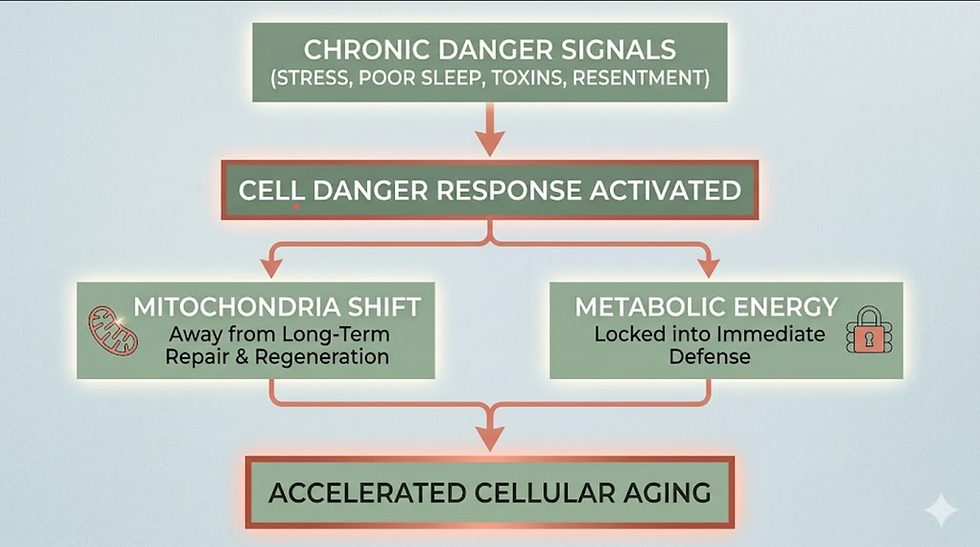
When your body reads chronic danger — from any of these signals — your cells make a survival decision: pull energy away from repair and pour it into defense. Your mitochondria stop optimizing for a long life and start optimizing for getting through the threat.
That defensive state is the Cell Danger Response. And when the signals never let up, it never switches off. The alarm keeps firing and repair keeps waiting.
That is the bottleneck — not a missing molecule, but cellular energy locked in defense. It is the driver I treat clinically, and it is the reason no supplement can ever be the whole answer: you cannot supplement your way out of an alarm that will not turn off.
And it is not sexy in the way marketing wants it to be. It is not shiny, nicely packaged nor instant. It requires attention, rhythm, restraint, courage, and self-respect. It requires us to stop treating the body like a machine that needs an upgrade and start understanding it as an intelligent biological system responding to the environment we create.
The body is not confused. It is adapting. If you are exhausted, inflamed, insulin resistant, anxious, hormonally depleted, sleep deprived, and metabolically unstable, your body is not failing you. It is responding to the inputs it has been given.
What the Longest-Lived People Do Instead
This is where modern longevity has become too shallow. We have reduced a profound biological and existential question — how do I live well for a very long time? — into a product category.
But the people who live into their 90s and 100s with vitality are not usually doing so because they found the perfect supplement stack. The longest-lived populations tend to have patterns of daily movement, real food, social connection, stress-reducing rituals, purpose, and community woven into ordinary life. (Blue Zones)
They do not outsource longevity to a bottle. They live inside an ecosystem that supports health. That is what we have lost. And because we have lost it, we try to purchase it back one product at a time.
This is the deeper truth: the path of least resistance is rarely the path of transformation. The harder path says:
Look at your life your sleep and muscle.
Look at your blood sugar and your stress chemistry.
Look at your hormones, your gut and your inflammation
Look at your nervous system.
Look at the grief you have never metabolized.
Look at the life you keep postponing.
Look at the habits that are aging you faster than time itself. That is not as marketable. But it is much more honest.
This does not mean supplements have no place. They absolutely can. I use supplements clinically. I recommend them when they are targeted, tested, and connected to a larger strategy.
When Supplements Actually Help
Supplements should serve the system. They should never replace the system. A targeted protocol can:
Help restore a critical nutrient or correct a deficiency
Support mitochondrial function and cellular energy production
Influence inflammatory pathways.
Support clearance, methylation, sleep, muscle, or hormones.
But it cannot become the entire philosophy of health. That is where people get misled.
The regulatory environment also matters. In the United States, the FDA does not determine whether dietary supplements are effective before they are marketed, and in many cases, companies can bring products to market without prior FDA review. (Office of Dietary Supplements)
That does not mean every supplement is unsafe or useless. It means the burden of discernment falls heavily on the consumer. And the consumer is tired, wants hope and control. The consumer wants an answer that feels doable.
So the industry sells certainty. But real longevity requires discernment. It requires the willingness to stop chasing the newest compound and start asking better questions.
Not “What supplement should I take to live longer?” But:
What is draining my cellular energy?
What keeps my body in a state of danger?
Where am I inflamed, depleted, under-muscled, under-recovered, overfed, undernourished, overstimulated, or disconnected?
What signals am I sending my biology every day?
What kind of life would my cells interpret as safe enough to repair?
That is the real longevity conversation.
The Better Question to Ask
Listen to What Your Body is Telling You The question is not simply, “What can I take?” The question is, “What is my body adapting to?”
That is where longevity begins. Not in the supplement aisle or in the latest anti-aging trend. Not in the promise that one molecule will rescue us from decades of mismatch between how humans are designed to live and how modern life demands that we function.
Longevity begins when we stop outsourcing our health to the easiest answer. It begins when we understand that living well into our 90s and 100s is not built from one intervention, but from a thousand repeated signals of repair.
Your cells are always listening. They are listening to whether nutrients are available. They are listening to whether energy demand matches energy production. They are listening to whether there is danger in the system. They are listening to cortisol, insulin, inflammatory cytokines, sex hormones, thyroid hormone, oxygen availability, mitochondrial output, gut-derived signals, and nervous system tone.
They are in brief, listening to your life.
Food is a signal.
Sleep is a signal.
Muscle is a signal.
Light is a signal.
Stress is a signal.
Connection, purpose, belief, love and safety are all signals.
Supplements can be part of the protocol. But your life is the protocol. And that is the truth we need to return to.
Not because it is easy.
Because it is real.
— Dr. Barbara Johnson
P.S. Supplements aren’t useless — I use them clinically every day. The problem is treating them as the whole strategy. So I pulled together a reference on the supplements that have actually been studied for longevity: what the evidence supports, what it doesn’t, and where the marketing runs past the science. Want it? Just reply to this email and I’ll send it your way.
The supplement reference still stands — but a reference won't tell you what your cells are reacting to. If you've optimized the inputs and you're still exhausted, inflamed, or foggy, the question isn't which supplement. It's what's keeping your cells in defense. That's what we measure and treat at The Johnson Center. Functional Health & Longevity. Book a Discovery Call →
Frequently Asked Questions
Do longevity supplements actually work?
Some do something; none do the thing the marketing implies. A supplement can correct a deficiency, support a single pathway, or move one marker. What it cannot do is reverse aging — because aging is not one missing molecule. It is a network of interacting mechanisms. And if your cells are locked in defense mode, no capsule overrides that signal.
Why aren't my supplements helping my fatigue and brain fog?
Because fatigue and brain fog are usually symptoms of cells that have pulled energy away from repair and into defense — the Cell Danger Response. A supplement cannot turn off an alarm that the rest of your life keeps re-triggering. Until you address what is keeping the alarm on, you are supplementing into a system that cannot use the input.
Do NAD+ supplements really slow aging?
There is no definitive clinical evidence in humans that NAD+ supplements slow aging or extend lifespan. They can raise NAD+ levels — but that is not the same as changing your rate of aging. NAD+ also rises with exercise, sleep, and real food, which are the inputs the bottle is trying to shortcut.
What is the Cell Danger Response?
It is the state your cells enter when they read chronic danger. Your mitochondria stop optimizing for repair and start optimizing for survival, pouring energy into defense instead. When the danger signals never stop, the response never switches off. That stuck state is the driver I treat clinically — and the reason a supplement can never be the whole answer.
Are any supplements worth taking for longevity?
Yes — when they are targeted, tested, and connected to a larger strategy. Correcting a real deficiency, supporting mitochondrial throughput, or influencing a specific inflammatory pathway are legitimate uses. The problem is not supplements. The problem is treating them as the entire philosophy of health.
Should I stop taking my supplements?
Not necessarily. The smarter move is to find out what is draining your cellular energy first, then layer targeted support on top of that. The question is not "what should I take." The question is "what is my body adapting to?"


Comments