
Perimenopause Brain Fog: Why Your Sharp Mind Disappeared at 45 (And What Actually Brings It Back)
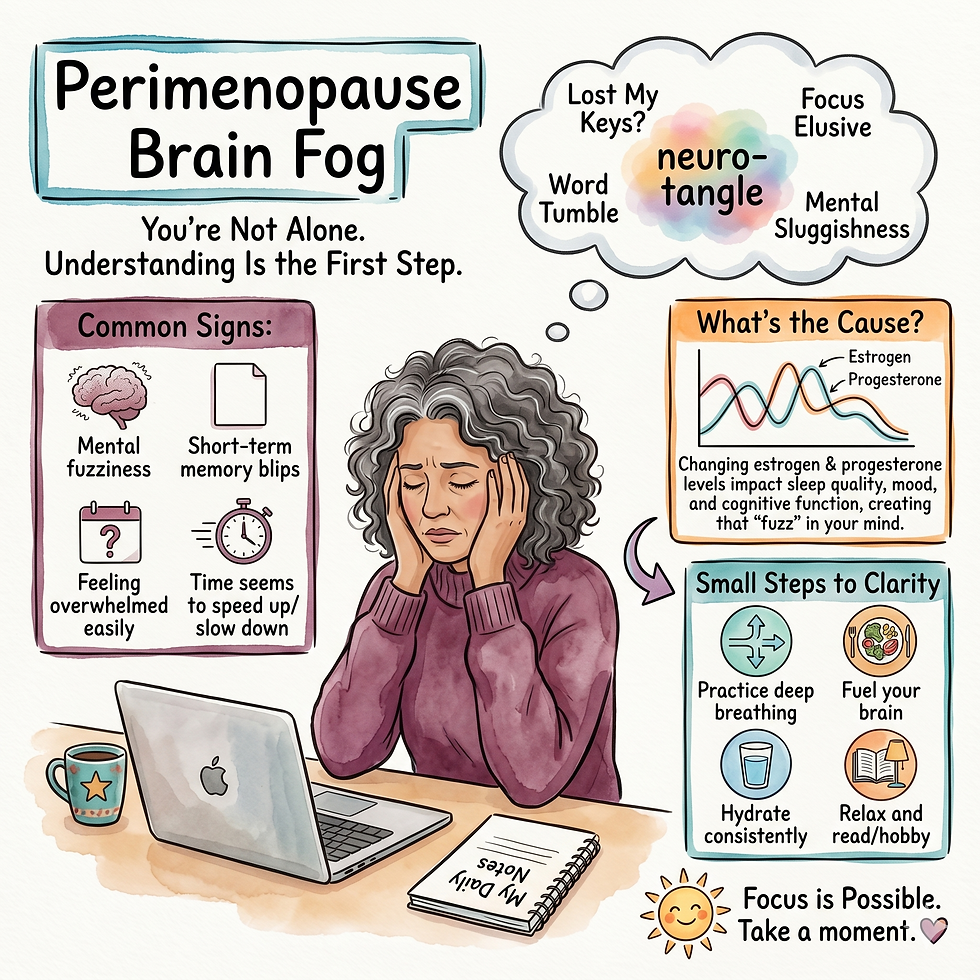
You were the one who could run a board meeting, manage three calendars, and remember every client's kid's name without writing it down.
Now you walk into a room and forget why. You lose words mid-sentence in front of people who used to take notes on what you said. You re-read the same email three times. You wonder, quietly, if something is actually wrong with your brain.
Your doctor ran labs. Everything's "normal." They suggested you sleep more, try meditation, maybe an SSRI. You left more frustrated than you came in.
Here's the truth nobody told you: perimenopause brain fog is a measurable biological event. Not stress. Not anxiety. Not "just getting older." It's a cellular, hormonal, and metabolic shift that conventional medicine routinely misses because they're not running the right tests and they're not connecting the right dots.
Between 60 and 70% of women in perimenopause report exactly what you're describing. You're not broken. You're not weak. You're not imagining it. And no, a magnesium gummy and a meditation app are not going to fix it.
Let's get into what is actually happening — and what actually works.
Is Brain Fog a Sign of Perimenopause?
Yes. And it usually shows up before the cycle changes most women associate with perimenopause.
The cognitive functions that get hit first are specific: processing speed, working memory, attention, and verbal recall. Translation: word-finding glitches, losing the thread in meetings, mental tasks that used to feel automatic now feel like wading through wet sand.
This is not a mood problem dressed up as memory loss. It's a domain-specific cognitive change driven by hormonal volatility — and the pattern itself is diagnostic. The fact that it fluctuates with your cycle, your sleep, and your stress is not a sign you're making it up. It's a sign your brain is responding to a hormonal environment that has lost its stabilizing signal.
Why Does Perimenopause Cause Brain Fog?
Three drivers, all happening at once. This is why single-fix solutions — one supplement, one hormone, one lifestyle change — keep falling short for women who do everything "right" and still feel foggy.
1. Estrogen volatility (not just low estrogen) destabilizes your brain's wiring
Estrogen is not just a reproductive hormone. It regulates serotonin, dopamine, and acetylcholine — the chemistry behind focus, mood, and memory. When estrogen swings, those systems lose their reference point.
Here's what most articles get wrong: the problem isn't low estrogen. It's the volatility. Imaging studies show the brain compensates by upregulating estrogen receptors in the hippocampus and prefrontal cortex — and that compensatory response itself correlates with worse memory performance. Your brain is working harder to track a moving target. That's the fog.
2. Cortisol and sleep enter a reinforcing loop that wrecks memory consolidation
As progesterone falls, you lose access to allopregnanolone — the neurosteroid that normally buffers your stress response. Your HPA axis becomes more reactive. Cortisol patterns get erratic.
Cortisol, when chronically elevated or poorly timed, directly impairs the hippocampus — the brain region that consolidates new memories. Hot flashes and night sweats then fragment your sleep, which spikes cortisol further, which damages the hippocampus further. This is a loop, not a one-way street. And it compounds every night you don't sleep through.
3. Your brain's fuel supply is dropping — and this is the piece most physicians miss entirely
Estrogen directly regulates how your brain uses glucose and how your mitochondria produce energy. Across the menopause transition, cerebral glucose metabolism drops measurably in the exact brain regions that are vulnerable to cognitive decline.
Translation: your brain is running on less fuel. Mental tasks that used to be automatic now require visible effort because the cellular machinery powering them is operating below capacity.
This is where the Cell Danger Response comes in — and where most clinicians stop looking.
The Piece Conventional Medicine Misses: The Cell Danger Response
When your cells perceive threat — hormonal chaos, chronic cortisol, environmental toxin load, infection, poor sleep, all the things you're carrying simultaneously — they don't just keep producing energy normally. They downshift into a protective state called the Cell Danger Response (CDR). Mitochondria stop optimizing for energy and start optimizing for defense.
That defense mode is what brain fog feels like.
Standard medicine doesn't measure this. A CBC and a TSH will not tell you whether your cells are stuck in CDR. They will come back "normal" while you sit in your car at 4pm trying to remember why you drove there.
This is the foundation of the Cellular Intelligence Protocol (CIP) — the system I developed specifically because the women walking into my practice were doing everything right and still couldn't think. CIP looks at the full picture: mitochondrial function, cellular stress markers, the hormonal network as a system rather than isolated numbers, and the metabolic terrain underneath all of it. That's where the answers are. That's where they've always been.
Why Won't My Doctor Listen to Me About Brain Fog?
Because the training and the tools don't match what you're describing.
Conventional medicine is built around finding one disease in one organ system using a narrow panel. Perimenopause brain fog is a multi-system, multi-driver phenomenon that doesn't fit that model. So a TSH comes back normal, a CBC comes back normal, and the next move is reassurance, an antidepressant, or "let's see how you do in a few months."
If that's the loop you're stuck in, the problem isn't that you're being dramatic. The problem is the testing isn't built for what you have.
How Long Does Perimenopause Brain Fog Last?
For most women, it tracks with the hormonal transition — anywhere from a few years to most of a decade — and improves as hormone levels stabilize after menopause completes.
But "waiting it out" is not a treatment plan. You don't get those years back. And the underlying drivers — cellular energy collapse, cortisol dysregulation, mitochondrial stress — don't quietly resolve on their own in every woman. Some accelerate into the postmenopausal years. Addressing them now is both a quality-of-life decision and a long-term brain health decision.
Is It Perimenopause Brain Fog or Early Dementia?
Almost always perimenopause. Dementia is global, progressive, and functional. Perimenopause brain fog is domain-specific, variable, and tied to hormonal patterns.
Get a deeper evaluation if you have:
Rapid onset of cognitive change rather than gradual
Trouble managing finances, medications, or familiar tasks
Word-finding problems that consistently get worse instead of fluctuating
Disorientation in places you know well
Any new neurologic symptoms
Those patterns warrant a workup for thyroid disease, B12 deficiency, sleep apnea, medication interactions, depression, or early neurodegenerative process. They are not features of typical perimenopausal brain fog.
What Actually Works for Perimenopause Brain Fog?
Here's where I'm going to call out the noise. The longevity space is drowning in biohacks that don't address the actual biology of what's happening to you. Cold plunges won't fix a cell stuck in danger response. A nootropic stack won't restore estrogen receptor signaling. A red light panel is not a stress-response intervention.
The interventions with real evidence behind them are less sexy and more effective:
Sleep — and this is non-negotiable. If you are waking at 3am with a racing brain and you "aren't even stressed," this is biochemistry, not personality. Progesterone metabolizes into allopregnanolone, which acts on GABA receptors — the same calming system targeted by anti-anxiety medications. As progesterone falls in perimenopause, you lose your endogenous off-switch, and an otherwise quiet brain becomes a wired one at night. Cognitive behavioral therapy for insomnia (CBT-I) has the strongest evidence base for restoring cognitive function in perimenopause, and addressing the hormonal driver of the wakefulness is part of the same conversation. If your sleep is fragmented, nothing else you do will compound. This is foundation, not optional.
Aerobic exercise as a clinical intervention. Large-effect benefits on sleep, mood, and cerebral blood flow. Not a vanity workout — a brain treatment. Most women in my practice are under-dosing this.
Mediterranean-pattern eating. Anti-inflammatory, metabolically supportive, sustainable. Not a 30-day reset. Not keto-carnivore-fasted-by-noon. The boring answer is the right one.
Mindfulness-based stress reduction. Real effects on the HPA axis. This is biochemistry - psychoneuroimmunology, not woo.
A real workup of the underlying cellular and hormonal terrain. B12, full metabolic panel, sleep apnea screening, anticholinergic medication review, comprehensive hormone panel, cortisol patterns, mitochondrial markers, cellular stress indicators. Not standard. Necessary.
A note on HRT: it is not, despite what the internet will tell you, a direct treatment for brain fog. The KEEPS-Cog trial was clear on this. HRT has real indications — vasomotor symptoms, genitourinary symptoms, bone protection — and it can help cognition indirectly by improving sleep, decreasing inflammation, increasing energy and reducing cortisol load. Anyone selling HRT as the cognitive fix is overstating the evidence. The decision needs to be made on its own merits, not on hype.
What Supplements Actually Help Perimenopause Brain Fog?
Most don't. The ones with the strongest mechanistic and clinical support address the underlying drivers — mitochondrial function, neuroinflammation, and the stress response. Generic recommendations are useless because the right protocol depends on what your cells are actually doing.
If you're spending several hundred dollars a month on a supplement stack and still feeling foggy, you don't need more supplements. You need to know what's actually wrong at the cellular level so the intervention can be targeted instead of scattered.
What This Means For You
If you are a high-functioning 45+ woman whose brain has stopped feeling like yours, you have not become someone different. You are running a brain operating in a hormonal environment it has never been in before, on fewer cellular resources, under more cortisol load, with less sleep. That is a solvable problem. It is not solvable with reassurance, an SSRI, or a magnesium gummy.
The investigation has to start with the cellular and hormonal terrain together — not as separate complaints — because that is where the layered biology actually lives. That is what the Cellular Intelligence Protocol was built to do.
If your labs look normal and your brain does not feel like yours, that is not a contradiction. That is a diagnostic gap. A discovery consultation at The Johnson Center for Health in Virginia Beach or Blacksburg, Virginia is the next step when you are ready to stop chasing symptoms and start addressing the system underneath them.
You do not have to slow down. You have to be evaluated properly. There is a real difference.
Frequently Asked Questions
Is brain fog a symptom of perimenopause? Yes. Studies report cognitive complaints in 60-70% of perimenopausal women. The most affected functions are processing speed, working memory, attention, and verbal recall.
What does perimenopause brain fog feel like? Forgetting words mid-sentence, losing the thread of a conversation, walking into rooms with no idea why, mental tasks that used to feel automatic feeling effortful, and concentration that comes and goes with your cycle.
At what age does perimenopause brain fog start? Most commonly between 40 and 50, often before menstrual cycle changes are obvious. Some women notice it as early as their late 30s.
How long does perimenopause brain fog last? It typically tracks with the hormonal transition — several years to most of a decade — and tends to improve once hormone levels stabilize postmenopause. It does not have to be tolerated in the meantime.
Can perimenopause brain fog be reversed? The hormonal volatility resolves with time, but the cellular and metabolic drivers underneath it respond to targeted intervention. Addressing sleep, cortisol load, mitochondrial function, and the cellular stress response usually produces measurable improvement.
Will HRT fix my brain fog? Not directly. The KEEPS-Cog trial found no significant direct cognitive benefit from hormone therapy at menopause. HRT can help cognition indirectly by improving sleep and reducing cortisol load, but it should not be prescribed as a cognitive treatment.
How do I know it's not early dementia? Perimenopause brain fog is variable, domain-specific, and tied to hormonal patterns. Dementia is progressive, global, and functionally impairing. Rapid decline, disorientation in familiar places, or functional impairment in finances and medications warrant a deeper neurologic evaluation.
Why are my labs normal but I still feel terrible? Standard panels (CBC, CMP, TSH) do not measure mitochondrial function, cellular stress response, or the full hormonal network. Normal labs on a narrow panel do not rule out the cellular and hormonal drivers of perimenopause brain fog.


Comments